


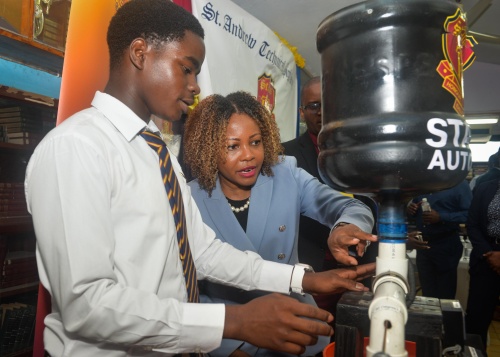
Procurement is under way for a renewable energy laboratory at St. Andrew Technical High School (STATHS).
Minister of Education, Skills, Youth and Information, Senator Dr. the Hon. Dana Morris Dixon, advised that the lab will be constructed over the summer holiday and is expected to be opened in September.
“Students will learn about solar technology. They’ll learn about solar installation. They will learn about the batteries. They’ll learn about wind power too. Using that lab, they will learn how to instal solar systems, how to monitor them, how to fix them and even look at other systems too, because it could be wind-based or other types of renewable energy solutions,” Dr. Morris Dixon said.
She was addressing an alumni engagement visit to St. Andrew Technical High School on Tuesday (April 14), in commemoration of the institution’s 65th anniversary, under the theme ‘Inspiring Change: Reshape, Realign, Refocus’.
During the visit, Dr. Morris Dixon toured the school’s Technical and Vocational Education and Training (TVET) facilities.
Grade-11 students Nathaniel Hurge and Cameron Pinnock delivered a presentation on STATHS Autopeck, an automated chicken feeder they developed in collaboration with two other students.
“Teachers are not able to monitor or find monitoring the chick-feeding process overnight a hassle. So, we came up with a design, an automated chicken feeder to tackle this problem,” Nathaniel shared.
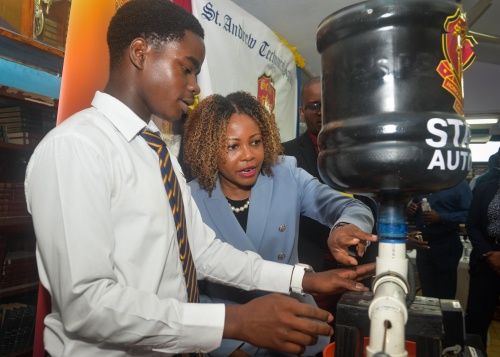
He explained that the device has two reduction motors which give it power and three 3D printed spiral screws which are placed clockwise, anticlockwise and in the middle to help with the downward movement of the feed.
“This device also comes with a timer module which you can set for how long you want it to feed and the time intervals in which the machine runs for,” he said.
The 16-year-old student added that the device features a weighted sensor to prevent overfeeding.
He explained that if the chicks are not eating as expected and too much feed is in the basins, the machine automatically shuts off once the basin is weighed.
“This device is not the first of its kind. This is just our specific design, and for future innovations we plan to programme an app to this device so that you can monitor it from anywhere,” he said.
Cameron shared that the project combined multiple industrial areas – electrical engineering, building construction, plumbing and visual arts.
He explained that the device was built in two weeks using materials such as reduction motors, a DC outlet, a five-gallon bottle, pipes and a switch.
“It was a task but we got through… . Our next plan is to add a solar system to this so that it doesn’t have to use electrical energy all the time,” Cameron said.