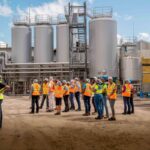


Tropical Battery Company Limited expects sales from its merged TRE KAYA renewable division to reach about $500 million annually on the low end over the next two to three years, underscoring the unit’s growing role in the group’s revenue mix.
The group is “streamlined for growth”, with renewables set to play a larger role alongside its battery engine, reasoned CEO Alexander Melville in a Financial Gleaner interview.
The forecast comes as the energy solutions company swung back to profit in fiscal 2025, reporting net income of $59.7 million for the year ended September 30, compared with a restated loss of $121.4 million a year earlier.
Revenue rose 14.6 per cent to $6.44 billion, lifted by core battery distribution and the first full-year contribution from Rose Batteries in the US. Gross profit climbed 26 per cent to $2.36 billion, while operating profit advanced to $527 million. Operating cash flow rebounded to $60.1 million, reversing an outflow of $377.9 million in the 2024 financial year. Net current assets improved to $270.9 million from a deficit of $34.7 million.
Integration and capital moves
Melville said the merger of Tropical Renewable Energy with KAYA Energy Group will create “one cohesive solar company” with stronger margins and larger project capacity. “The unified renewable energy business is expected to be a key driver of growth for the group,” he told the Financial Gleaner. Renewables are projected to contribute “8.0 to 14 per cent of group revenue”, he said. This equates to roughly $500 million a year at the low end based on 2025 revenue levels. That compares with KAYA’s revenue of $157 million in 2025 and $354 million in 2024. The financials did not disaggregate the revenue from Renewable Energy Ltd, Tropical Finance Ltd and Tropical Mobility as it was “not considered material for consolidation and disclosure”.
Capital was also strengthened through its additional public offering (APO) last July that raised $643.5 million after expenses, which raised shareholders’ equity to $1.6 billion from $1.05 billion. Tropical used debt to acquire Rose Batteries, which pushed its long-term debt-to-equity to 270 per cent in 2024, but the APO eased it back to 156 per cent.
Restated base
Management corrected prior omissions related to interest on Sygnus financing on-lent to Tropical Battery USA LLC, and recognised previously unrecorded share-based payment expenses. The adjustments widened the 2024 financial year net loss and reset opening equity.
Cash and leverage
Year-end cash stood at $211.5 million, down from $461.7 million, reflecting repayments and capex. Loans and borrowings totalled $4.32 billion. Short-term debt includes a $300-million bond due April 2025; management said talks with bondholders are under way to extend the maturity. Lease liabilities increased as premises were consolidated.
Finance costs rose to $657.5 million, but the group still delivered profit before tax of $47.0 million and a tax credit of $12.7 million, reflecting jurisdictional effects and the tail end of Junior Market remissions before the August 19 migration to the JSE Main Market.
Revenue mix and growth drivers
Melville described Tropical’s revenue base as “well-diversified”. Batteries accounted for about 80 per cent of revenue, accessories and services 8.0 to 9.0 per cent, renewables 4.0 to 5.0 per cent, with the remainder from EV-related and specialty lines. Growth drivers include battery export expansion, double-digit increases in solar projects and more value-added services tied to storage and mobility.
Management changes and structure
Oliver Hill ended full-time duties as CEO of the majority-owned subsidiaries at year end, shifting to a consultant role. Solar operations are now fully integrated under KAYA Energy Group, led by Karina Chez and Andrew Cramer, with David Walton overseeing Tropical Mobility and serving as general manager of Tropical Battery Company Limited. Management said consolidation “is expected to accelerate growth and profitability by operating as one cohesive solar company”.
On the Enervate joint venture with CAC 2000, Melville said the TRE KAYA merger “preserves the integrity of our existing partnerships”. Tropical holds a $5-million carrying interest, has guaranteed a $125-million loan, and reported no material trading during the year.
APO, market migration and shareholders
The APO broadened the shareholder base, issuing 372.5 million new shares. Migration to the JSE Main Market ended tax remission, but positioned the company among larger peers. Basic EPS improved to 3.9 cents from a loss of 11.7 cents.
neville.graham@gleanerjm.com