


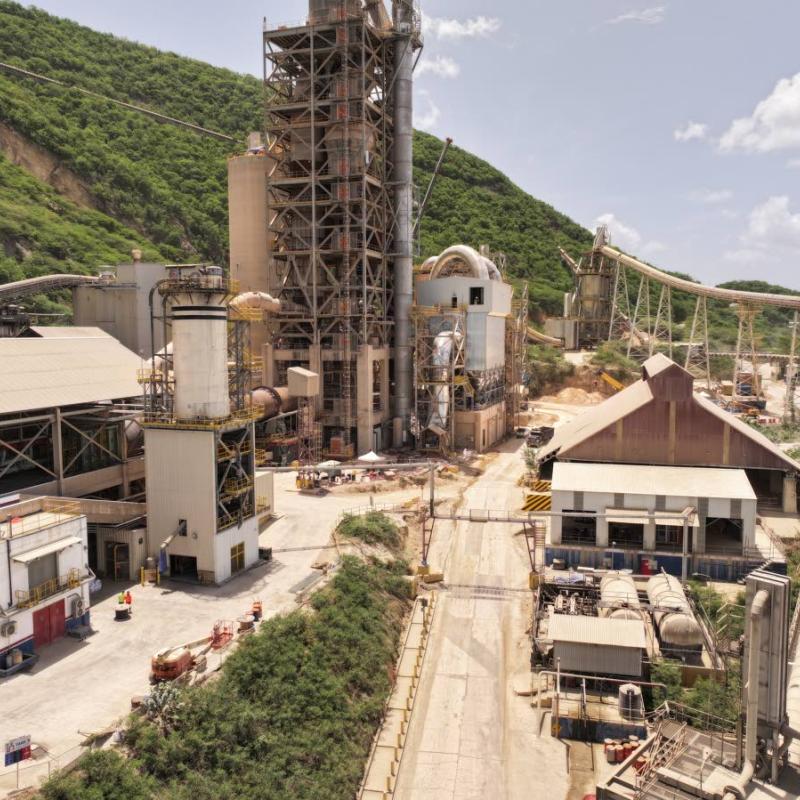
The kiln expansion at Caribbean Cement Company Limited (CCCL) failed to lift output past one million tonnes in 2025 as production dipped below 2020 pandemic levels, according to data in its annual report.
Going forward, operations could see “uncertainty” with higher input costs due to oil shocks caused by the US-Iran war, the annual report warns.
Its kiln – the equivalent of an industrial furnace – was completed and commissioned in April–May 2025, after which Hurricane Melissa struck last October, causing temporary disruptions.
KILN DELIVERED, BUT OUTPUT LAGGED
The kiln “investment significantly improved operational efficiency” and in some respects outperformed expectations, according to management’s discussion and analysis in the annual report.
“The successful completion of the kiln debottleneck project fully achieved – and in some cases exceeded – its objectives related to safety, cost, schedule, emissions compliance, and production performance, increasing clinker capacity to 2,850 metric tonnes per day,” stated Jorge Alejandro Martínez Mora, managing director of CCCL, in the report.
Overall, cement production fell to 864,000 tonnes in 2025, lower than the 870,000 tonnes recorded in 2024, and lower than all years going back to 2020 when the company produced 940,005 tonnes. It did, however, better the 2019 level of 758,830 tonnes.
From an operational perspective, the company maintained a stable performance throughout 2025, explained Chairman Parris A. Lyew-Ayee in his remarks in the report. “Management continued to prioritise investments aimed at improving efficiency and strengthening [the] overall operational effectiveness”.
EXPORTS
The US$42-million, or J$6.7-billion, kiln debottleneck and modernisation project was designed to push annual output from one million to beyond 1.3 million tonnes. Hurricane Beryl in July 2024 and Hurricane Melissa in October 2025 compressed second-half operating windows in back-to-back years, arguably blunting the post-upgrade production step-up.
The company did cross one threshold of strategic significance: it exported 3,000 metric tonnes of cement to Curaçao in September 2025 – with management signalling intent to “seriously embark on exporting cement” as capacity allows.
“This achievement reflects the successful completion of the [kiln] Debottleneck Project, strengthening capacity and positioning the Company for future opportunities,” stated management.
INPUT COSTS
The US-Iran war threatens to inflate Caribbean Cement’s input costs, according to its annual report.
The conflict “has significantly disrupted global oil and gas supplies” and driven “sharp increases in energy prices” at a time when energy represents one of the largest cost line items in cement manufacturing. Caribbean Cement’s kiln requires sustained temperatures exceeding 1,400 degrees Celsius, primarily fuelled by petroleum coke and coal, leaving the company directly exposed to price volatility emanating from the Strait of Hormuz disruption.
CCCL spent $4.3 billion on fuel and electricity in 2025, down from $4.6 billion in 2024, according to notes in the annual report.
“Despite this backdrop, the domestic market is expected to remain relatively resilient,” the report stated, citing Hurricane Melissa reconstruction, tourism developments, government infrastructure works, and private housing demand.
In response, CCCL said it would produce to fill demand while keeping costs low, framing its strategy in management jargon: “[We] will continue to execute strategies aimed at optimising productive capacity and enhancing operational efficiency to capitalise on favourable local market conditions. The company remains committed to further strengthening stakeholder relationships”.
This performance also unfolded against the backdrop of the ongoing Russia-Ukraine conflict, which continued to exert pressure on global energy markets and supply chains.
REVENUE UP, PROFIT FLAT
The 2025 results were broadly solid. Revenue rose 13 per cent to $31.5 billion from $27.9 billion, driven by higher domestic volumes and pricing. Net profit came in at $5.9 billion, essentially flat against $5.95 billion in 2024, as escalating operating costs and working capital movements tied to the kiln project absorbed the revenue gains.
The royalty and service fee paid to Cemex – its ultimate parent – for the use of intellectual property rose from 2.0 per cent of consolidated net sales to 3.0 per cent, effective January 2025, under a framework approved by shareholders that permits a ceiling of 4.0 per cent. The result: royalty and service fees of $753 million in 2025, up from $493 million in 2024.
The company paid $1.79 billion in dividends during the year. Trinidad Cement Limited, a subsidiary of Cemex, holds 74 per cent of CCCL through direct and indirect stakes, with a further 4.96 per cent held directly by Cemex Operaciones México.
EMISSIONS DOWN
The kiln upgrade delivered the lowest CO₂ emissions per tonne of cement in the 2020–2025 period, at 659.2 kilogrammes per tonne, with alternative fuel usage rising 6.4 per cent. The comparative figure was not immediately available.
“All cement dispatched during 2025 met the Jamaica Standards and American Society for Testing and Materials product specifications,” stated the management.
business@gleanerjm.com