


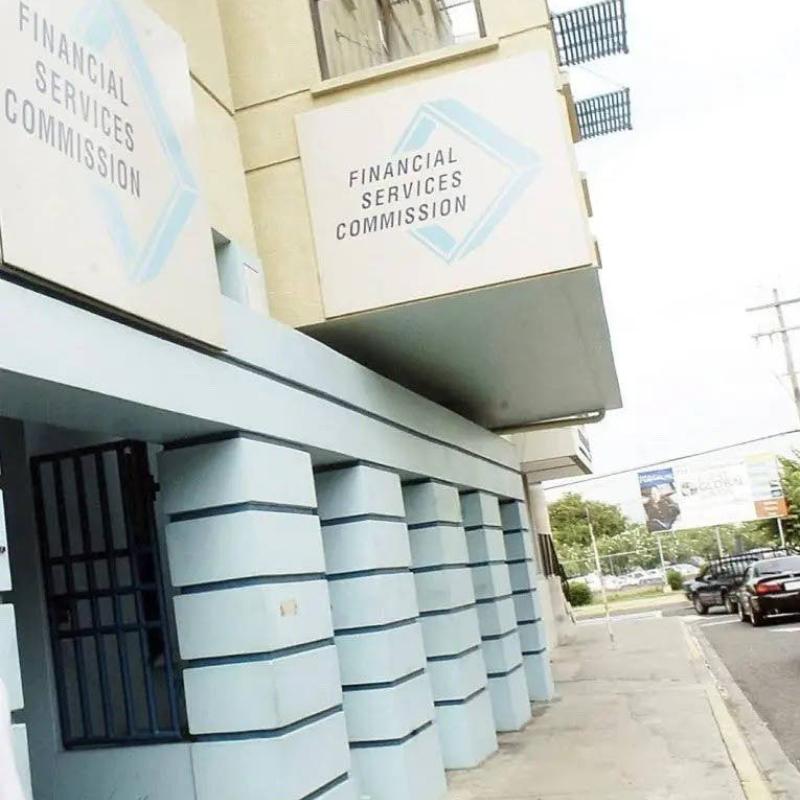
The Financial Services Commission (FSC) closed public consultation on Wednesday on guidelines that would require insurance companies and securities dealers to keep board-approved recovery plans setting out how they would survive a severe financial shock. The window ran from August 17 to September 16.
The regulator said the framework would “reduce the likelihood of disorderly failure or reliance on extraordinary public or governmental support” and “ensure continuity of critical functions and services”.
The rules would land within a stable but fluctuating financial sector. The insurance sector comprises of six life insurance companies and 11 general insurance firms. Life assets totalled $791 billion, up 28 per cent year-on-year due to reinsurance inflows arising from Hurricane Melissa. But from a capital perspective, both entities recorded year-on-year reductions: Life insurance capital and surplus totalled $126 billion to March from $132 billion a year earlier, with general insurance capital at $27 billion in March, down from $32 billion a year earlier.
The securities sector — comprising 33 firms, held $987 billion in balance sheet assets and $1.67 trillion in funds under management. Capital reached $147 billion, or roughly 14.9 per cent of total assets against a benchmark of 6.0 per cent. Return on equity, however, dipped to 1.16 in March from 10.54 per cent in December.
The funding question
Repos, however, account for roughly 80 per cent of total liabilities. The sector’s strength rests on a funding model that reprices continuously and depends on clients rolling over.
The guidelines speak to exactly that. Recovery plans must carry “at least three stress scenarios” — idiosyncratic, system-wide, and combined — and “at least one scenario should assess the impact of a severe liquidity stress”. Another must test “a sudden and material deterioration in capital adequacy”. Dealers would have to model, in other words, the failure of the arrangement that currently funds two-thirds of their assets.
What the guidelines require
The proposals cover “all prescribed financial institutions and financial holding companies as defined by the Financial Services Commission (Amendment) Act, 2024 operating in the insurance and securities sector”. Rather than set a size threshold, the commission would apply the requirement in proportion to an institution’s “size and business volume; complexity of activities and group structure; risk profile; and systemic importance”. Groups would file one consolidated plan capturing each prescribed institution within the group, including foreign subsidiaries and branches.
Each plan must run to eleven components, from an executive summary through to core business lines, critical functions, dependencies, recovery options and communication arrangements. Firms would set indicators calibrated to give “advance warning of deteriorating conditions, allowing time for management to consider and implement recovery actions”, and triggers that “should not be set at, or below, regulatory minimum levels”. On a breach, on activation of a recovery option, or on any event that materially impairs the plan, firms must notify the commission “promptly within three business days, unless the FSC specifies otherwise”.
A busy fortnight
The consultation closed two days after the commission stood up two new departments. A Market Growth and Development Department and an Innovation Unit, the latter carrying the FSC’s first regulatory sandbox, both took effect on September 14 under letters signed by Executive Director Lieutenant Colonel Keron Burrell.
business@gleanerjm.com