

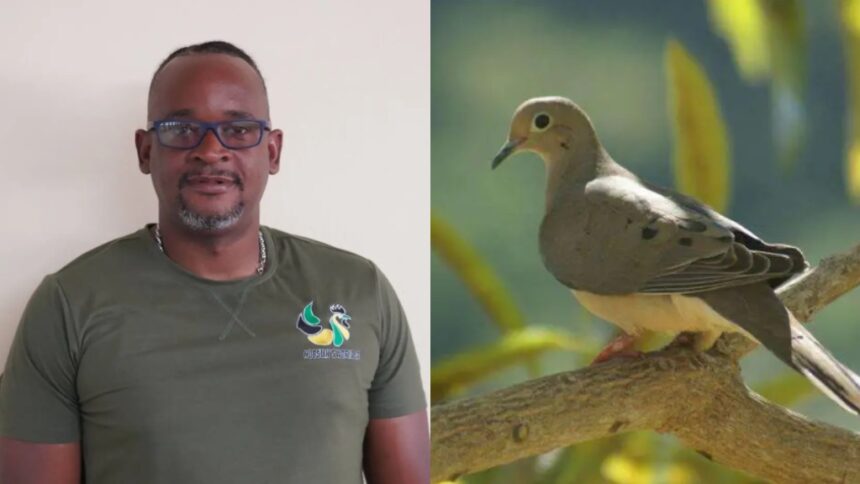
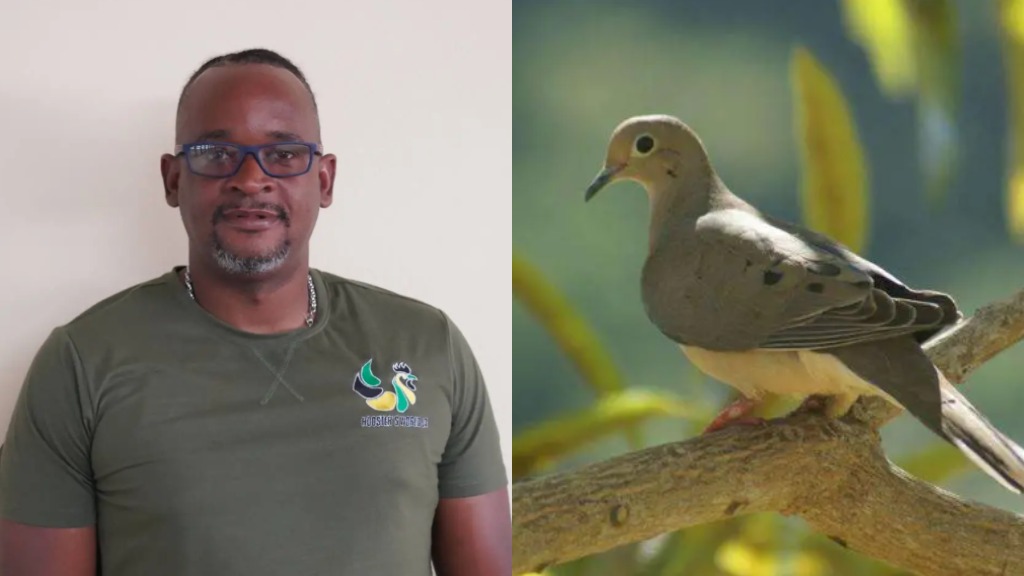
Terrestrial biologist and member of BirdLife Jamaica, Damion Whyte and a Zenaida Dove.
Experts are cautioning that Jamaica may be moving too quickly to reopen the bird shooting season following Hurricane Melissa, which devastated the island’s forests and left bird populations struggling for food, shelter and survival since October 2025.
Their concerns come after the National Environment and Planning Agency (NEPA) announced that the Natural Resources Conservation Authority (NRCA) has granted approval in principle for a restricted bird shooting season for 2026.
NEPA indicated that the upcoming season will likely have geographic restrictions and a reduced number of hunting events.
However, the experts argue that even a restricted season could put additional strain on already vulnerable bird populations.
Stressing that Hurricane Melissa was one of the strongest hurricanes ever to hit Jamaica, terrestrial biologist and member of BirdLife Jamaica, Damion Whyte, pointed to widespread forest destruction and unusual bird behaviour in the aftermath.
“There were reports in the BirdLife Jamaica group, where people showing videos, pictures of birds, who you normally don’t see, like the ball plates, white-crowned pigeon, on the ground (which you can’t shoot)…Mountain Witch and some other birds…the parakeet, all came in because the ones that are dependent on fruits, couldn’t find it, so they come pon the ground and they come around people…it was a massive thing,” Whyte shared.
Months later, as Jamaica considers whether to proceed with a bird shooting season, some conservationists believe those images should settle the argument.
BirdLife Jamaica, a leading advocate for the protection of the country’s birds, has called for the season to remain closed, arguing that decisions on the reopening should rely on transparent, science-based assessments of post-hurricane bird population recovery.
It pointed to Forestry Department estimates that 51 per cent of Jamaica’s forests were damaged including up to 25 per cent of mangrove forests. In western and northern parishes, it said damage was estimated at 76 per cent to 100 per cent canopy loss, representing almost total devastation of habitats for wild birds.
The hurricane’s damage extended beyond trees. Fruit disappeared, nesting sites vanished and stressed birds became easier preys for predators and humans. Members of BirdLife Jamaica have also reported drastic reductions in bird populations in affected parishes, with some formerly common species now totally absent.
For months, the conservationists have been feeding wild birds with fruit and seeds because natural food sources have not fully recovered.
As such, Whyte says science must guide the country’s response.
“My recommendation: let data rule. You going to have one group who going to tell you no hunting for sure and you have another who might say have it. However, at times we have to remember the precautionary, if we don’t have enough information, we choose to take the choice of protecting the birds,” he explained.
Research already suggests that wildlife across Jamaica is struggling after the storm. Whyte cited a study on fruit bats showing reduced body weight, likely due to fruit shortages.
“Somebody might say the trees come back but are these trees providing fruits?…When we look pon the fruit bats, some of the fruit bats that we sampled were less lighter than the ones last year. And that makes sense because they only eat fruits and when a hurricane come, it mash up the fruits,” the biologist explained.
Whyte, however, admitted that the decision had to consider other factors.
“There are other people who are concerned about the look of it. When I say the look, some people have it that bird shooting is a ‘big man’s’ sport. And you have people with house mash up and all of that, and you a have bird shooting,” he posed.
Bird shooting has long been a tradition in parts of rural Jamaica and provides economic benefits for hunters and local communities. Cancelling a season carries financial consequences for many people already struggling after the hurricane.
“The bird shooting season provides economic [benefits] for the hunters and the bird boys that go collect it, the community member weh house dem, it’s a whole industry…And with not having a season, that industry get affected. However, one of the reasons why you have a bird shooting season is to protect the birds…Your season should not affect or put the birds at risk of extinction,” Whyte told Observer Online.
All factors considered, Whyte said a precautionary approach is required.
“Personally…I wouldn’t have a problem if the season is stopped for the year, because there’s a lot of information that we don’t have, and I would go to the precautionary concept. So until we get enough information, we nah go hurt and kill,” he said. “On the other hand… if they do have a season, it can’t be the same like last year, because whether we like it or not, the birds were impacted.”
Jamaica’s game birds—four species of native doves and pigeons—are vital to the island’s ecosystems, supporting forest recovery by dispersing seeds, contributing to agriculture and attracting birdwatching tourism. A properly regulated hunting season is potentially sustainable, BirdLife Jamaica says, as long as it is determined on the basis of sound science and expert advice in a transparent decision-making process.
However, both Whyte and BirdLife Jamaica raised concerns about NEPA’s capacity for monitoring and enforcement of bird shooting and wildlife infractions. In addition, Whyte said reducing hunting areas could concentrate hunting pressure, putting additional stress on surviving bird populations while also increasing conflict among hunters competing in tighter spaces.
He also raised concerns about how they would choose hunting locations.
“Some of these communities, especially down in the west, I don’t know how they’re going to select where you can shoot or not. But don’t it kinda feel a way say they out there a shoot and your house nav on no roof? Those are things that you have to think about,” he said.
The conservationists are urging open dialogue among hunters, regulatory bodies, scientists, and the public to ensure decisions about bird shooting are grounded in science and conservation priorities. They emphasised that the precautionary principle should guide any decision, giving birds and their habitats time to recover fully.