


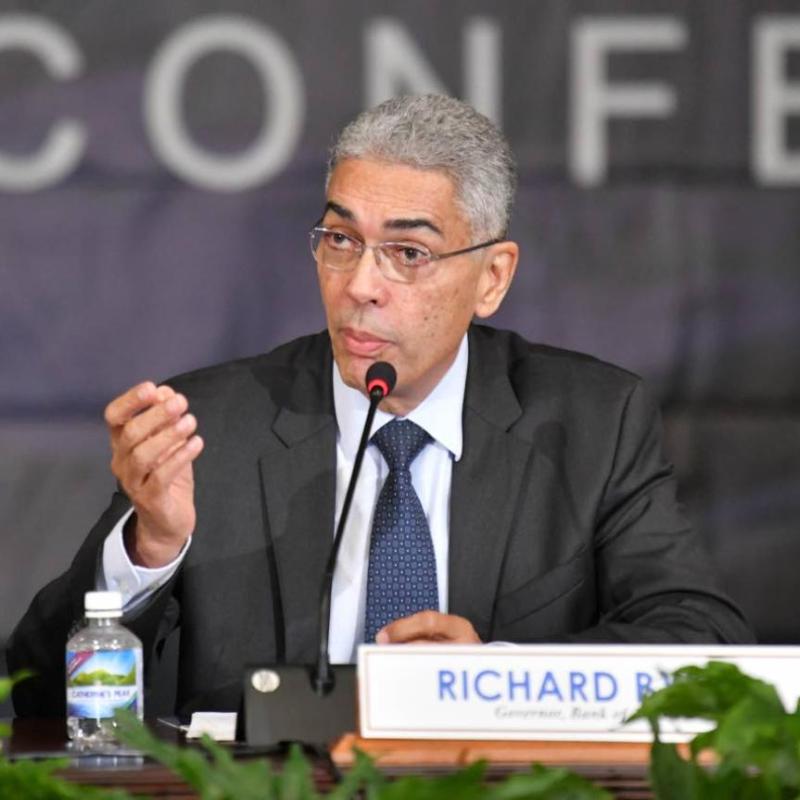
No commercial bank failed in Jamaica during his nearly seven years at the helm of the Bank of Jamaica (BOJ), outgoing Governor Richard Byles told Parliament’s Standing Finance Committee on Wednesday — a record he set against a backdrop of local and global shocks.
“Despite profound international disruptions in recent years, we have had no bank failure in Jamaica,” Byles said about the eight commercial banks. “We do not take this fact for granted.”
Comparatively, he said the Federal Deposit Insurance Corporation of the United States reports that there have been “19 bank failures” in the United States over the seven years, 2019 to 2026.
The distinction matters. Stocks & Securities Limited, a securities dealer, collapsed in 2018, largely under the watch of the Financial Services Commission — not the BOJ. It was placed into receivership after regulators determined it was insolvent. SSL clients, including sprinter Usain Bolt, are part of a client pool seeking to recover funds.
The matter fuelled calls for the BOJ to assume regulatory oversight of securities dealers under the proposed Twin Peaks supervisory model. Byles said that reform is now nearly ready for Cabinet consideration.
Competition fix in train
Byles also discussed Jamaica’s highly concentrated banking sector with the two largest banks — NCB and Scotiabank, together holding more than half of deposits and half of loans, according to state data.
“We have discussed other means of creating more competition, some of which I’m not able to elaborate on here, but which are in train and will be announced by the appropriate person,” Byles said.
On monetary policy, he acknowledged that the concentrated banking structure limits the effectiveness of the central bank’s interest rate signals.
Inflation headed for breach
Inflation, currently at 4.3 per cent, is forecast to breach the upper limit of the four to six per cent target range in the June and September quarters, driven by crude prices that rose 59.4 per cent between March 1 and May 20. Private-sector price-setters surveyed by the BOJ are now projecting inflation of 7.1 per cent.
Gross international reserves stood at US$6.5 billion at his departure, up from US$3.6 billion when Byles took office in 2019. The Jamaica dollar appreciated 1.5 per cent year-over-year to J$157.90 to US$1 as at the end of May.
Real GDP fell four to six per cent in March 2026 due to the lingering effects of Hurricane Melissa last October. Recovery of one to three per cent is projected for 2026-27.
No successor has been named. Finance Minister Fayval Williams launched the search in April. Byles leaves office on August 18.
“It has been the honour of my professional life to lead this fine Jamaican institution for almost seven years,” he said.
Byles was appointed governor on August 19, 2019 after retiring from Sagicor Group Jamaica, where he served as president and CEO. He also served as the first private-sector co-chair of Jamaica’s Economic Programme Oversight Committee, formed to monitor Jamaica’s performance under its International Monetary Fund-supported reform programme.
Jamaica’s capital markets have navigated a succession of overlapping shocks — from the COVID-19 pandemic and global supply chain disruptions to the Russia-Ukraine war, Middle East conflict, and monetary tightening in major economies — all of which tightened financial conditions and drove volatility in energy and commodity prices. Domestically, Hurricanes Melissa and Beryl compounded the pressure, disrupting economic activity, straining foreign exchange markets, and raising fiscal demands for reconstruction. Through it all, the Bank of Jamaica has maintained overall financial stability.
On the record of his tenure, he was unapologetic.
“Over the period September 2019 to April 2026, Jamaica experienced average annual inflation of 6.0 per cent,” he told the committee. “If we take out April 2021 to March 2023 — the period of global supply chain inflation — Jamaica’s inflation rate averaged 5.0 per cent.” The BOJ seeks to keep inflation within a band of 4.0 to 6.0 per cent.